
NFL
They Wanted Love Songs—In 2016 Beyoncé Brought “Formation” to the Super Bowl, Sparked Police Boycott Threats, and Turned Halftime Into a National Reckoning. In 2016, ignoring calls for a “safe” performance, Beyoncé unleashed her new single, “Formation,” at Super Bowl 50. Her dancers wore outfits inspired by the Black Panther Party and formed an ‘X’ shape, transforming the halftime show into a fierce political statement on race and injustice. The performance, watched by 115.5 million people, sparked widespread outrage, with police unions threatening a boycott of her tour. Read how she used the world’s biggest stage to awaken a nation. 🔗:

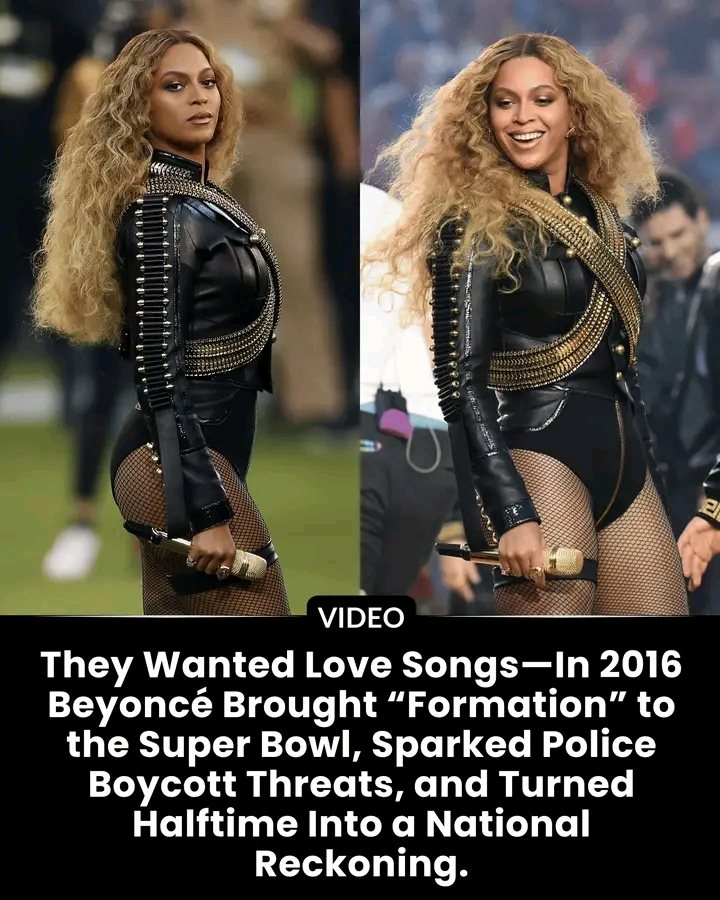
They Wanted Love Songs—In 2016 Beyoncé Brought “Formation” to the Super Bowl, Sparked Police Boycott Threats, and Turned Halftime Into a National Reckoning.
The Halftime Revolution: How Beyoncé’s “Formation” Caused a National Political Earthquake at Super Bowl 50
On February 7, 2016, at Super Bowl 50, headliners Coldplay and Bruno Mars were swiftly overshadowed by a performance that transcended entertainment and ignited a national controversy: Beyoncé’s fiery, politically charged rendition of her new single, “Formation.” Instead of the expected “safe” pop spectacle, Beyoncé used the world’s most-watched television event as a platform for a powerful statement on race, culture, and police brutality. The quote, “They wanted me to sing about love — I singed about Black Power,” perfectly summarizes the artist’s decisive pivot from pop icon to unapologetic cultural provocateur.
The Statement: Black Power and Malcolm X
Beyoncé’s performance was dense with political symbolism, celebrating Black history and affirming the Black Lives Matter movement. The outfit: Beyoncé herself wore a black leather bodysuit with a gold military-style sash, an homage to Michael Jackson’s 1993 Super Bowl outfit, but her dancers’ attire was the true political centerpiece. Her all-Black female dancers sported Afros, berets, and black leather outfits, directly channeling the iconic uniform of the Black Panther Party—a nod that coincided with the 50th anniversary of the group’s founding. The choreography: In a key moment of the routine, the dancers formed a massive ‘X’ shape on the field, widely interpreted as a tribute to the civil rights leader Malcolm X and the Black liberation movement. The message: One moment that solidified the political intent was a placard held up by one of the dancers that read, “Justice 4 Mario Woods,” referencing the 26-year-old Black man who had been shot and killed by police in San Francisco, the Super Bowl’s host city, a few months prior.
The Controversy and Data
The immediate reaction was a cultural schism. While many praised her bold, affirming message of Black culture and female empowerment, conservative critics and law enforcement groups were outraged, viewing the performance as “anti-police” and inappropriate for the stage. Political condemnation: Former New York City Mayor Rudy Giuliani stated it was “outrageous that she used it as a platform to attack police officers.” Police boycotts: Police unions across the country, including the Miami Fraternal Order of Police, called for a boycott of her subsequent “Formation World Tour” due to the perceived “anti-police message.” An “anti-Beyoncé” protest was planned outside the NFL headquarters in New York City, though it was countered by a larger group of supporters, with reports noting only three anti-Beyoncé protesters showed up to face a larger pro-Beyoncé crowd. Viewership: Despite the intense controversy, the Super Bowl 50 Halftime Show (headlined by Coldplay, with special guests Bruno Mars and Beyoncé) was watched by
A moment that silenced the entire stadium: Coco Gauff dropped her racket, rushed into her parents’ embrace at center court, tears streaming down her face, and whispered words that sent chills through millions – “”Family is strength, not a burden”” – Not a slogan, not an easy truth, but a deep truth that made fans cry, opponents moved, and social media exploded with viral clips… This was not just a match, but a story about family, resilience, and what truly matters most in life – you won’t be able to hold back your emotions after watching this historic moment of the “”Golden Girl”” of American tennis! The full story is in the comments 👇
🚨 HOLY SMOKES. KAROLINE LEAVITT UNLEASHED!
PATRICK MAHOMES BREAKS HIS SILENCE ON LIVE TELEVISION: CALLS T.R.U.M.P “A VICIOUS OLD BASTARD DRAINING AMERICA’S SOUL” AFTER THE BORN-IN-AMERICA ACT

🚨 BREAKING — SENATE SHOWDOWN ENDS WITH A VANCE VICTORY

10 MINUTES AGO: Former Trump lawyer Jenna Ellis has pleaded guilty in the Georgia election interference case, admitting her role in efforts to overturn the 2020 results. As part of her deal, Ellis has agreed to testify against D0nald Trump if called FULL DETAILS

🚨BREAKING: Articles of Impeachment have officially been filed against Gov. Tim Walz in the Minnesota See more
SHOCKING NEWS rippled through the tennis world when Coco Gauff, the brightest star of American tennis, 005
BREAKING: Senator Mark Kelly hits Pete Hegseth with a massive lawsuit for violating the Constitution by trying to decrease his military rank and pay in a blatant act of partisan abuse.
BREAKING: Republican Senator Thom Tillis enrages MAGA world by announcing that he will block ALL of Trump’s appointments to the Federal Reserve in response to the sham investigation into Jerome Powell.
🚨 JUST IN — TRUMP RESPONDS TO RENEE GOOD’S DEATH 🇺🇸
