
NFL
The best witness for the never-completed prosecution of President Trump, it turned out, was the prosecutor himself: Jack Smith. Last week, the House Judiciary Committee released the transcript and video of Smith’s deposition, which is a stark reminder of the cost of letting Trump go unpunished and the danger of the President’s revenge-seeking against those who sought to hold him to account. “Smith’s deposition was, in all likelihood, as close as he will get to making a closing argument,” Ruth Marcus writes. “It marks, most likely, the unsatisfying conclusion of an unsatisfying episode, one that underscored the limitations of the criminal-justice system in dealing with a lawless President.” Now, with Trump calling Smith a “criminal” who should be “investigated and put in prison,” one question is the jeopardy that Smith himself may face. “I am eyes wide open that this President will seek retribution against me if he can,” Smith said at one point in the deposition. Still, he said, of his testimony before the committee, “I came here. I was asked to come here.” Read more :

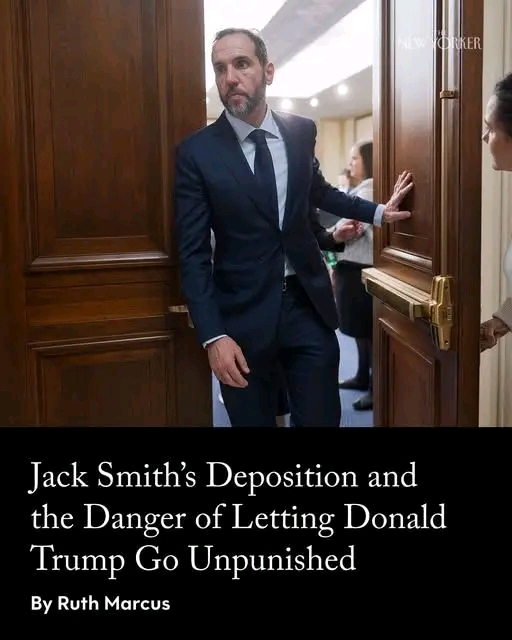
Jack Smith’s Closing Argument
In a moment charged with legal gravity and national consequence, Jack Smith delivered what many observers describe as a defining closing argument—one that distilled months of investigation into a clear, uncompromising case centered on evidence, intent, and the rule of law.
Rather than lean on rhetoric, Smith’s approach focused on methodical clarity. Point by point, he laid out a narrative prosecutors believe demonstrates deliberate actions, conscious decisions, and a pattern that could not be explained away as confusion, politics, or mistake.
A Case Built on Evidence, Not Emotion
At the heart of Smith’s closing argument was a simple assertion: accountability depends on facts. He emphasized timelines, documented communications, witness testimony, and corroborating records to show intent and awareness.
Legal analysts noted that Smith avoided inflammatory language, choosing instead to rely on the cumulative weight of the evidence. The message was unmistakable—this was not about ideology or personalities, but about conduct measured against the law.
“This case is not complicated,” Smith said in substance. “It is detailed—but the facts are clear.”
Intent as the Central Question
A key theme in Smith’s argument was intent. Prosecutors argue that actions taken were not accidental or misunderstood, but purposeful and sustained. Smith carefully walked through moments where choices were made despite warnings, advice, or legal obligations—framing those decisions as pivotal.
In legal terms, establishing intent is often the hardest burden. Observers say Smith treated it as the spine of the case, returning to it repeatedly to show consistency rather than coincidence.
The Rule of Law Above All
Perhaps the most striking element of Smith’s closing was his insistence that status offers no immunity. Without naming political consequences, he reinforced a foundational principle: the law applies equally, regardless of power, position, or public profile.
This framing resonated beyond the courtroom. Constitutional scholars say it echoed a long-standing democratic ideal—that institutions endure only if rules are enforced without fear or favor.
Reaction and National Impact
Reaction to the closing argument was swift. Supporters called it disciplined and persuasive; critics argued it was overly rigid. But even skeptics acknowledged the seriousness of its construction.
Across Washington, the argument reignited debate about accountability at the highest levels and the long-term implications for democratic norms.
What Comes Next
With closing arguments complete, attention now turns to legal outcomes and broader consequences. Whatever the result, Smith’s closing argument has already secured a place in the ongoing national conversation about justice, power, and responsibility.
In the end, the argument was less about a single case and more about a larger message: that the strength of a democracy is tested not when the law is easy to apply—but when it is hardest to enforce.
And in that test, Jack Smith made clear where he believes the line must be drawn.

🚨 BREAKING: Republicans just REMOVED a spending provision placed by Somali Rep. Ilhan Omar that would’ve sent $1 million to a fraudulent “clinic” in Minnesota

the music world is in shock after , visibly shaken, confirmed that the 37-year-old woman fatally shot by ICE agents was a relative of his—an incident that unfolded just hours before his highly anticipated appearance in New York.

BREAKING: Five Republican Senators DEFY Trump and break ranks to pass a vote to neuter his military power in a shock betrayal. If Donald Trump believed he could bomb another country, kidnap its president, and claim its oil reserves without pushback from a neutered Congress, he was faced with a rude awakening today as the usually compliant senior chamber of the federal legislature finally awoke from its torpor. READ MORE :

🚨 BREAKING: Tim Walz has been referred to the Department of Justice for possible criminal charges over alleged complicity in the Somali fraud case.

BREAKING: In a rare show of bipartisan defiance, nine House Republicans crossed party lines to advance a Democrat-led bill that would extend Affordable Care Act (ObamaCare) subsidies for the next three years. The procedural vote marks a significant early win for House Democratic Leader Hakeem Jeffries and his caucus, signaling cracks in Republican unity on health care just as the stakes intensify. Debate on the bill is happening right now, with a final vote expected shortly. If these nine Republicans continue siding with Democrats, millions of Americans could see their ACA health insurance subsidies preserved through 2028. All eyes are now on whether this fragile bipartisan alliance will hold…

“This is a line that couldn’t be ignored.” A bombshell leaked memo has just triggered a political earthquake in Washington, as 47 members of Congress—including 16 high-ranking Republicans—formally demand President Trump’s immediate resignation. The classified document alleges a chilling abuse of power. With GOP committee chairmen now openly breaking ranks, the administration is in a total tailspin. Is this the definitive turning point for the presidency? See the full details of the memo and the bipartisan uprising in the comment below.

JUST IN: Taylor Swift breaks down in tears while addressing the tragic Minneapolis shooting that left 37-year-old Renee Nicole Good dead during an ICE enforcement operation. She revealed that a doctor rushed in to provide emergency aid, only for ICE agents to pull their guns on him—threatening to shoot if he didn’t back away. Let that sink in. A woman was killed, and a doctor who tried to save her life was allegedly threatened at gunpoint. Swift didn’t hold back. She went on to sharply criticize Donald Trump over his remarks on the incident—and then revealed what many say they’ve been waiting to hear…

BREAKING: Donald and Melania Trump arrested by Chinese special forces after failing to escape by golf cart *Satire* 😉

No one breathed when he appeared. Adele had paused mid-set, tears already glimmering, and whispered, “There’s someone here tonight who taught me that songs can save lives.” Then the lights shifted — and there he was. Neil Diamond. Eighty-four. Fragile, slow, but radiating something holy. The O2 erupted as Adele ran to him, holding him like family. Together they sang “Hello Again,” then “Someone Like You,” voices woven through decades of heartbreak and hope. When Neil lifted his hands into a heart and whispered, “What I do have, I want to give,” the arena wept as one… FULL VIDEO BELOW 👇👇👇

A FEW MINUTES AGO: Candi Gauff publicly spoke out about Coco Gauff with a choked, emotional voice: “It’s time for me to speak — there are things my daughter has carried in silence for far too long, and not everyone her age is strong enough to endure what she has.” After days of choosing to remain quiet, Candi Gauff revealed Coco’s current mental and emotional state for the first time, while explaining why the recent period has been the most difficult stretch of her career — not only on the court, but also in her life away from the spotlight. She spoke about the invisible weight of expectations, the relentless competition schedule, the constant public scrutiny, and the moments when Coco had to face loneliness on her own, unseen by most people. “There were nights when my daughter cried in silence,” Candi said, “not because she lost a match, but because she was afraid she was no longer allowed to be vulnerable.” Her words left the tennis world in silence — a painful, raw, and honest truth, powerful enough to ignite a wave of compassion and unwavering support for Coco Gauff from fans around the globe. Full details in the comments👇👇👇
🔥 GLOBAL TURNING POINT: THE MOST SHOCKING NEWS IN SPORTS HISTORY! Basketball legend Michael Jordan has just made a shocking announcement that has stunned the world: he has chosen promising young tennis player Coco Gauff as the new global ambassador for the Air Jordan empire, with a massive $30 million contract, marking the first time in history that a female tennis player has “conquered” the basketball realm! ⚡ From spectacular slam dunks to lightning-fast dunks, will the fire of basketball blend with the power of tennis, or is MJ preparing a revolution that will make long-time fans scream: “Oh my God, Air Jordan shoes now smell like clay at Roland Garros!”
